

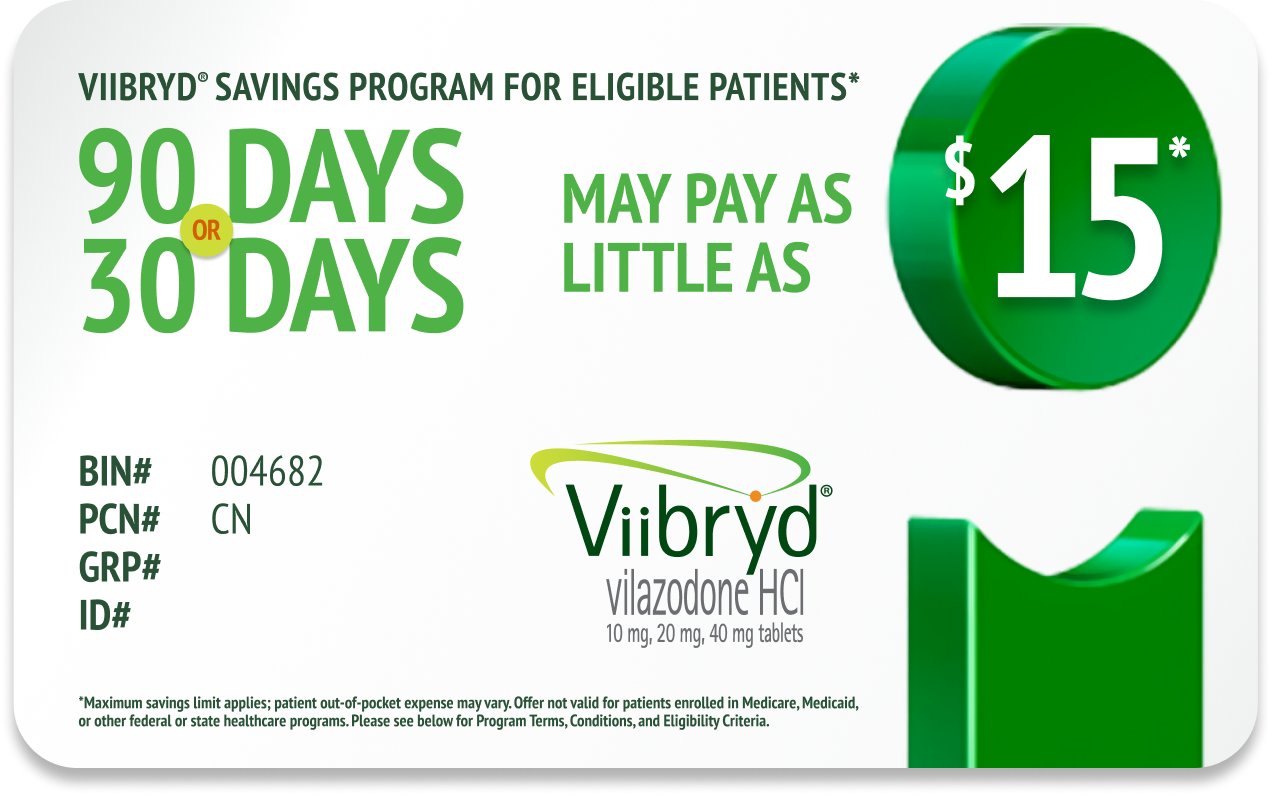
With a Viibryd Savings Card, eligible* patients may pay as little as $15 for a 90-day or 30-day prescription—that's as little as $5 a month, or 17¢ per day, with a 90-day prescription.
To see if you qualify for the Savings Card, fill out the form below.
Do you have private/commercial prescription insurance?
Privacy Notice
AbbVie may collect your personal data through your online and offline interactions with us, including your contact data, demographic, geolocation, and health-related data…
+ Expand for more information
Need help with your Savings Card?
Call us at 1-877-271-9952 for more information.
*Viibryd Program Terms and Conditions: 1. This offer is valid only for patients 18 years of age or older and is good for use only with a valid prescription for VIIBRYD® (vilazodone HCl) at the time the prescription is filled by the pharmacist and dispensed to the patient. 2. Depending on your insurance coverage, most eligible patients may pay as little as $15 per 30-day supply for each of up to twelve (12) prescription fills OR per 60-day supply for each of up to six (6) prescription fills OR per 90-day supply for each of up to four (4) prescription fills. Check with your pharmacist for your co-pay discount. Maximum savings limits apply; patient out-of- pocket expense will vary. 3. This card is not valid for use by patients enrolled in Medicare, Medicaid, or other federal or state programs (including any state pharmaceutical assistance programs), or private indemnity or HMO insurance plans that reimburse you for the entire cost of your prescription drugs. Patients may not use this offer if they are Medicare-eligible and enrolled in an employer-sponsored health plan or prescription drug benefit program for retirees. This offer is not valid for cash-paying patients. 4. AbbVie reserves the right to rescind, revoke, or amend this offer without notice. 5. Offer good only in the USA, including Puerto Rico, at participating retail pharmacies. 6. Void where prohibited by law, taxed, or restricted. 7. This card is not transferable. The selling, purchasing, trading, or counterfeiting of this card is prohibited by law. 8. This card has no cash value and may not be used in combination with any other discount, coupon, rebate, free trial, or similar offer for the specified prescription. 9. This offer is not health insurance. 10. Subject to all other terms and conditions, the maximum annual benefit that may be available solely for the patient’s benefit under the co-pay assistance program is $1,540.00 per calendar year. The actual application and use of the benefit available under the co-pay assistance program may vary on a monthly, quarterly, and/or annual basis depending on each individual patient’s plan of insurance and other prescription drug costs. 11. By redeeming this card, you acknowledge that you are an eligible patient and that you understand and agree to comply with the terms and conditions of this offer. 12. To learn about AbbVie’s privacy practices and your privacy choices, visit https://abbv.ie/corpprivacy.
VIIBRYD® (vilazodone HCI) is a prescription medicine indicated for the treatment of major depressive disorder (MDD) in adults.
VIIBRYD and other antidepressants may increase suicidal thoughts or actions in some people 24 years of age and younger, especially within the first few months of treatment or when the dose is changed. VIIBRYD is not for use in children.
Depression or other serious mental illnesses are the most important causes of suicidal thoughts or actions. Some people, including those with (or with a family history of) depression, bipolar illness, or a history of suicidal thoughts or actions may have a higher risk of suicidal thoughts or actions. Pay close attention to and call your healthcare provider right away to report any new or sudden changes in mood, behavior, thoughts or feelings.
Call your healthcare provider right away if you have any of these symptoms, especially if they are new, worse, or worry you:
Attempts to commit suicide; acting on dangerous impulses; acting aggressive or violent; thoughts about suicide or dying; new or worse depression; new or worse anxiety; panic attacks; feeling agitated or restless; new or worse irritability; trouble sleeping; an extreme increase in activity or talking (mania); or other unusual changes in behavior or mood.
Do not take VIIBRYD if you take a monoamine oxidase inhibitor (MAOI), have taken or will take an MAOI within 14 days of taking VIIBRYD, or are being treated with the antibiotic linezolid or intravenous methylene blue.
Serotonin syndrome: A potentially life-threatening problem called serotonin syndrome can happen when VIIBRYD is taken with certain other medicines. Stop taking VIIBRYD and call your healthcare provider or go to the nearest emergency room right away if you have any of the following: agitation; hallucinations; confusion; coma; fast heartbeat; blood pressure changes; dizziness; sweating; flushing; high body temperature; tremors, stiff muscles, or muscle twitching; loss of coordination; seizures; nausea, vomiting, or diarrhea.
Increased chance of bleeding: Taking VIIBRYD with aspirin, nonsteroidal anti-inflammatory drugs (NSAIDs), warfarin, or blood thinners may add to this risk. Tell your healthcare provider right away about unusual bleeding or bruising.
Manic episodes: Symptoms may include greatly increased energy, severe trouble sleeping, racing thoughts, reckless behavior, unusually grand ideas, excessive happiness or irritability, and talking more or faster than usual.
Discontinuation symptoms: Do not suddenly stop VIIBRYD without first talking to your healthcare provider. Stopping VIIBRYD suddenly may cause serious side effects, including: nausea, sweating, changes in mood, headache, irritability and agitation, tiredness, dizziness, problems sleeping, electric shock sensation, hypomania, anxiety, ringing in your ears, confusion, and seizures.
Seizures or convulsions.
Glaucoma (angle-closure glaucoma): VIIBRYD may cause an eye problem called angle-closure glaucoma. Call your healthcare provider if you have changes in your vision or eye pain.
Low salt (sodium) levels in the blood: This may be serious and may cause death. Elderly people may be at greater risk for this. Symptoms may include headache; difficulty concentrating; memory changes; confusion; weakness; and unsteadiness, which can lead to falls.
In severe or more sudden cases, symptoms include hallucinations, fainting, seizures, coma, respiratory arrest, and death.
Sexual problems: Taking VIIBRYD may cause sexual problems. Talk to your healthcare provider if you develop any changes in your sexual function or if you have any questions or concerns about sexual problems during treatment.
-
Tell your healthcare provider about any medical conditions
or if you:
- Have or have a family history of suicide, depression, bipolar disorder, mania or hypomania
- Have or had bleeding problems
- Have or had seizures or convulsions
- Have high pressure in the eye (glaucoma)
- Have low salt (sodium) levels in your blood
- Drink alcohol
- Are pregnant or plan to become pregnant. Taking VIIBRYD late in pregnancy may lead to an increased risk of certain problems in your newborn. Talk to your healthcare provider about the risks to your baby if you take VIIBRYD during pregnancy. If you become pregnant during treatment with VIIBRYD, talk to your healthcare provider about registering with the National Pregnancy Registry for Antidepressants at 1‑844‑405‑6185
- Are breastfeeding or plan to breastfeed. It is not known if VIIBRYD passes into breast milk. Talk to your healthcare provider about the best way to feed your baby during treatment with VIIBRYD
-
Tell your healthcare provider about all prescription and
over-the-counter medications, vitamins, and herbal
supplements you are taking or plan to take,
especially:
- MAOIs
- Medicines used to treat migraine headaches known as triptans
- Tricyclic antidepressants
- Lithium
- Tramadol, fentanyl, meperidine, methadone, or other opioids
- Tryptophan
- Buspirone
- Amphetamines
- St. John's Wort
- Medicines that can affect blood clotting, such as aspirin, nonsteroidal anti-inflammatory drugs (NSAIDs), and warfarin
- Diuretics
- Medicines used to treat mood, anxiety, psychotic or thought disorders, including selective serotonin reuptake inhibitors (SSRIs) and serotonin-norepinephrine reuptake inhibitors (SNRIs)
Ask your healthcare provider if you are not sure if you are taking any of these medicines. Your healthcare provider can tell you if it is safe to take VIIBRYD with your other medications.
VIIBRYD may affect the way other medicines work, and other medicines may affect how VIIBRYD works. Do not start or stop any medicines while taking VIIBRYD without talking to your healthcare provider.
Do not drive, operate heavy machinery, or engage in other dangerous activities until you know how VIIBRYD affects you. VIIBRYD can cause sleepiness or may affect your ability to make decisions, think clearly, or react quickly. Avoid drinking alcohol while taking VIIBRYD.
The most common side effects of VIIBRYD include diarrhea, nausea or vomiting, and trouble sleeping. These are not all the possible side effects of VIIBRYD.
Call your doctor for medical advice about side effects.
You are encouraged to report negative side effects of prescription drugs to the FDA. Visit www.fda.gov/medwatch or call 1-800-FDA-1088.
If you are having difficulty paying for your medicine, AbbVie may be able to help. Visit AbbVie.com/PatientAccessSupport to learn more.
Please see full Prescribing Information, including Boxed Warning, and Medication Guide.


For additional information about VIIBRYD, call AbbVie Medical
Information toll-free at 800-678-1605.
VIIBRYD® and its design are registered trademarks
of Allergan Sales, LLC, an AbbVie company.
© 2026 AbbVie. All rights reserved.
The product information provided in this site is intended only
for residents of the United States. The products discussed on
this site may have
different product
labeling outside of the United States. The health information
described on this site is for educational purposes only and is
not
intended to substitute for
discussions with a healthcare provider.
US-VBD-260003 08/26